
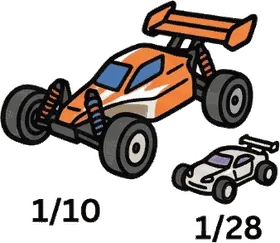
Scale
A number like 1/10 means the car is about a tenth of the real one's size. Common scales run from a small 1/16 to a big 1/5; the bigger, the more space and money it takes.
Check the scale used at a nearby track.
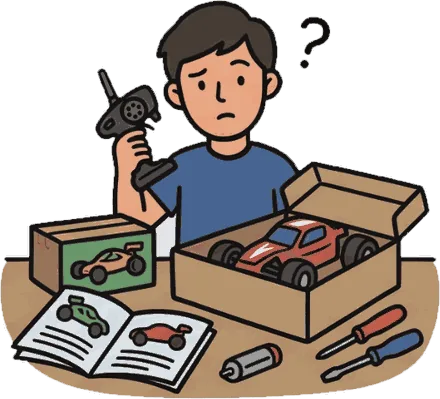
Many beginners quit because they bought the wrong car or expected too much. Read this first, about five minutes, before you spend any money.
A number like 1/10 means the car is about a tenth of the real one's size. Common scales run from a small 1/16 to a big 1/5; the bigger, the more space and money it takes.
Check the scale used at a nearby track.
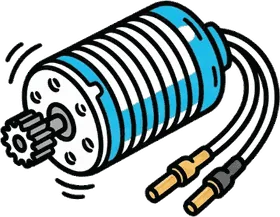
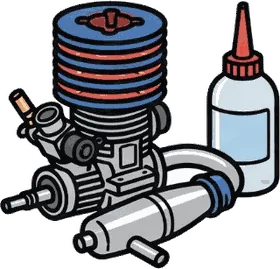
Electric cars use a motor and a battery: charge, then go. Nitro cars use a small engine on special fuel: the sound is fun, but tuning and upkeep are more involved.
For beginners, electric is far easier.
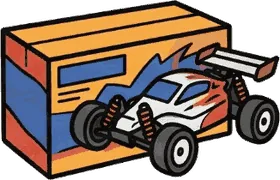

An RTR (Ready to Run) comes fully built with its radio, so you can drive right away. A kit is built from scratch: slower, but you learn what is inside your car.
Many start with an RTR, then move to kits.
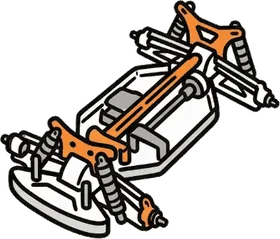
The frame of the car. Every other component mounts on it.
Turns the wheels. Brushed is cheaper; brushless is faster and lasts longer.
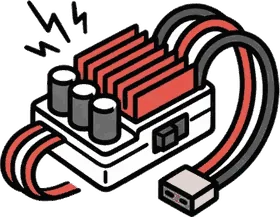
The speed controller. It feeds power from the battery to the motor according to the throttle.
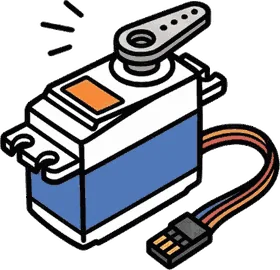
Moves the steering. It turns the front wheels as the radio commands.
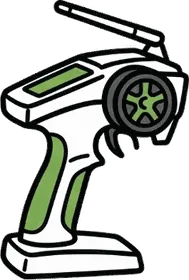
The radio in your hand: a trigger for throttle and brake, a wheel for steering.
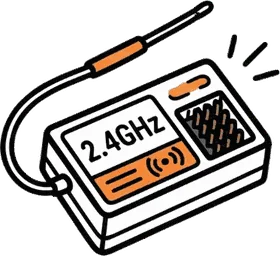
Receives the radio signal inside the car and passes it to the ESC and servo.
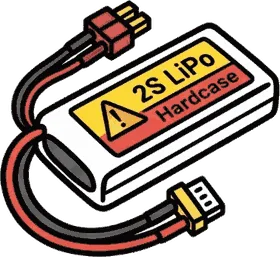
The power source. 2S means two cells; more cells means more speed.
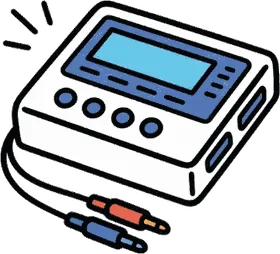
Charges the battery. Choose one that can balance charge for LiPo.
Check the rules first Before buying a motor, ESC, and battery, check the class rules in your area. Organisers and communities set different limits, such as motor type, KV or turn limits, and battery cell count. Ask the event committee or a local community so you don't buy the wrong thing. See events · Ask a community
The surface decides the kind of car. On-road cars sit low and run fast, good for asphalt or smooth floors. Off-road cars sit high and are tough, good for dirt and jumps. If you are not sure yet, a buggy or monster truck is more forgiving and works on many surfaces.
See 26 tracks and their surfacesPrice rises with the motor, chassis materials, and electronics. The cheapest tier is enough to learn on; the top tier has features beginners rarely need. Budget for an extra battery, a charger, and a few spare parts too. A good brand often costs less in the long run because it lasts and its parts are available.
Budget breakdown with real pricesAsk prices at 28 RC shopsThis hobby involves a lot of taking apart and rebuilding, so support matters. Choose a brand with full manuals, tutorial videos, and parts sold by many shops. The source guide names Tamiya, Traxxas, and ARRMA as examples. People in your community are usually the quickest help.
Find friends in 9 communities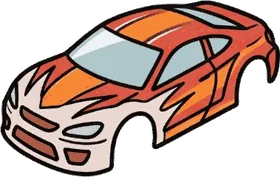
While learning you will crash and roll over a lot.
Strong bumpers, an enclosed gearbox, a thick chassis, splash-proof electronics. Avoid exposed gears and bodies that are too thin.
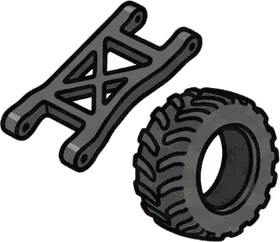
Sooner or later something will break.
A brand whose spare parts many shops sell. Before buying, ask the shop whether parts for that model are in stock.
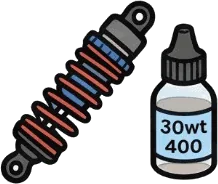
Your skill grows faster than you expect.
A motor, shocks, and gears that can be swapped. Avoid toy-grade cars whose motor or battery cannot be removed.
A battery that runs out quickly makes for short sessions.
A removable battery, LiPo support, and a decent charger.
Smooth control makes learning much easier.
A 2.4 GHz radio with proportional throttle and steering. Better still if speed can be limited for practice.
The battery that comes with an RTR runs out fast, so bring a spare that fits your car. NiMH is safer and easier to charge; LiPo is more powerful but strict. Pick a charger with balance charging.
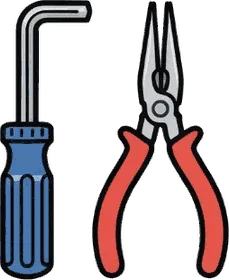
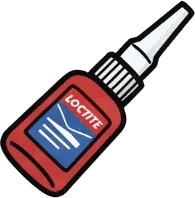
Hex drivers (1.5, 2.0, 2.5 mm) with hard tips so screw heads do not strip. Needle-nose pliers for small parts, thread lock for the motor mount and suspension, and silicone oil for tuning the shocks.
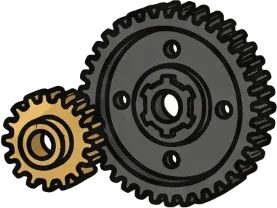
Keep the parts that break most often: tires, suspension arms, dogbones, axles, and pinion gears. With spares in your bag, a breakage at the track is fixed in minutes, with no waiting for a delivery.
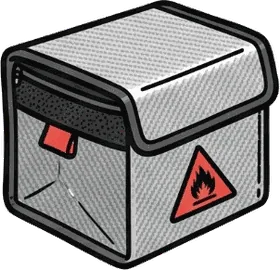
A damaged or wrongly charged LiPo battery can catch fire. Always charge inside a LiPo bag and never leave it unattended.
 BlogBudget main RC buat pemula: realistisnya habis berapa?Upcoming eventsClusterBugs Timeless Ride Fest12 DecMeetupsDrive together, everyone pays their own way
 BlogMau rakit kit pertama? Siapkan ini dulu
 BlogSama-sama 1/10, kok bodinya nggak muat?50 videosLearn from videos91 termsRC dictionary
Yes. Electric cars are easier to use and need little maintenance, so you spend your time driving rather than tuning an engine.
A good, well-kept beginner car usually lasts about 3 to 6 months before a major component needs replacing. It depends on how and where you drive.
No. With an RTR you still learn through maintenance and repairs. A kit gives deeper understanding but takes patience.
A hobby RC can be repaired and upgraded because every part is sold separately, and its throttle and steering are proportional, not just on and off. A toy RC usually cannot be fixed once it breaks.
1/10 has the widest choice of parts and is the most common at tracks. Small scales such as 1/18 to 1/28 cost less and can be driven at home. Check what your friends and the nearest track run first.
Brushed is enough to learn driving and costs less. Brushless is faster and lasts longer, but a car that is too fast makes beginners crash more. Many start brushed and switch once they are comfortable.
Yes, if you follow the rules: use a proper charger, charge inside a LiPo bag, never leave it unattended, and do not run it completely flat. If unsure, start with NiMH.
It depends on the battery capacity, the motor and how you drive. Most people bring two or three batteries so they can keep driving while one charges.
Better not on a road with traffic: it is risky for your car and for other people. Look for a field, an empty car park, or a track. At a track you also meet people you can ask.
Many have splash-resistant electronics, but bearings, shafts and screws can still rust. After water or mud, dry the car and lubricate it. Waterproof does not mean it can be submerged.
At RC shops and workshops, or online stores. That is why you should check parts availability before buying a car. Brands widely used in your community are usually the safest bet.
Yes, and it is the best thing to do before buying. See what people run, ask around, and get a feel for it. Some places also rent cars; ask the track owner.
There is no fixed rule. A child who can follow rules and hold the radio can usually start with a slow car, with an adult nearby, especially around batteries.
Not required, but it helps a lot. You get people to drive with, somewhere to ask questions, and news about used parts and meetups.
Summarised and adapted from the beginner guide by EuroRC. Prices and availability in Indonesia differ; ask a shop.